



World Pharmacists Day Spotlight – Rumbidzai Chidawanyika
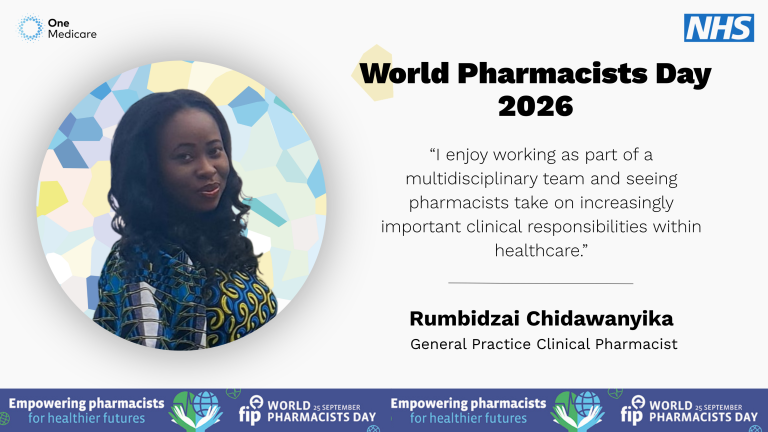
World Pharmacists Day recognises the vital and fast-evolving role pharmacists play in healthcare. To mark the occasion, Rumbidzai Chidawanyika, one of our General Practice Clinical Pharmacists at OneMedical Group answered some questions about her career in pharmacy, what drives her, and how the profession is changing.
Can you tell us a bit about your role at OneMedical Group?
I am an Independent Prescribing Clinical General Practice Pharmacist at OMG. My role involves supporting patients and the wider practice team through medication reviews, hypertension and minor illness clinics, high-risk drug monitoring, blood-test reviews, prescription management and medicines optimisation. I also support in the Prescribing Incentive Scheme which is a local NHS scheme designed to help GP practices improve the quality, safety and cost-effectiveness of prescribing
I also contribute to clinical governance, audits, QOF and CQC searches, reconcile hospital and specialist correspondence, support cost-effective prescribing, work with community pharmacies and safeguarding teams, and provide training to other staff.
What made you choose pharmacy as a career?
I chose pharmacy because I have always enjoyed chemistry and biology, but wanted a career where I could directly improve people's health. Pharmacy allows me to combine scientific knowledge, clinical decision-making and patient care, while working both independently and as part of a multidisciplinary team.
What was your career path to get here?
I studied A Levels in Maths, Chemistry and Biology, followed by a Master's degree in Pharmacy at the University of Brighton and postgraduate studies at the University of Manchester. I completed my preregistration training in a hospital, which gave me a strong clinical foundation. I then progressed into general practice, where I have developed my clinical decision-making, confidence and ability to provide direct patient care.
Is there a patient story that has stuck with you?
One memorable example involved a patient who initially declined a statin after a QRISK assessment because he did not want to take another medication. I took time to understand his concerns and explained the reasons for recommending treatment and how it could reduce his cardiovascular risk. After discussing the benefits, he felt more comfortable and agreed to start the medication. It reinforced the importance of patient-centred communication, shared decision-making and taking time to understand patients' concerns.
What's the most rewarding part of being a pharmacist?
The most rewarding part is making a positive difference to patients' lives. I enjoy identifying medication-related problems, optimising treatment and helping patients understand and manage their medicines. I enjoy that my role is always expanding to more responsibilities such as discuss blood test results and running specialist clinics
I also enjoy working as part of a multidisciplinary team and seeing pharmacists take on increasingly important clinical responsibilities within healthcare. We are able to review more complex patients and make clinical decisions that are in the best interest of the patient whilst using a patient-centred approach that ensures that patients are involved in the decision making of their care.
What's one thing people might not know about the role of a pharmacist?
Many people still associate pharmacists mainly with dispensing medicines, but the role has developed significantly. Pharmacists can undertake medication reviews, monitor high-risk medicines, interpret blood results, manage long-term conditions, conduct clinical audits and, where appropriately qualified, prescribe independently. Services such as Pharmacy First also demonstrate the expanding role pharmacists have in providing direct clinical care to patients.